
Private fine-tuned compliance RAG
What this is
Section titled “What this is”A regulatory-intelligence RAG stack that does two things stock embedding servers can’t.
Hot-loaded LoRA encoder. The base answerdotai/ModernBERT-base model lives on the GPU once. A named profile (us-regulatory) flips on the sugiv/modernbert-us-stablecoin-encoder LoRA adapter (8.77 MB, r=16, α=32) at request time and produces a domain-adapted 768-dim embedding. No separate deployment, no separate container, no model swap. Add another domain by adding another profile block to a YAML.
Custom cross-encoder that reranks and prunes in one pass. A PruningHead MLP (525K params) sits on top of a frozen BAAI/bge-reranker-v2-m3. The classifier output is the rerank score for sie.score(); the per-token hidden states become keep / drop probabilities exposed through sie.extract(). So one forward pass does both, and the surviving spans become the LLM context. Average compression: 74% character-count reduction on the reranked passages.
Everything needed to host this lives in server-plugin/ as a thin Docker-baked extension on top of the public sie-server image.
The pipeline
Section titled “The pipeline”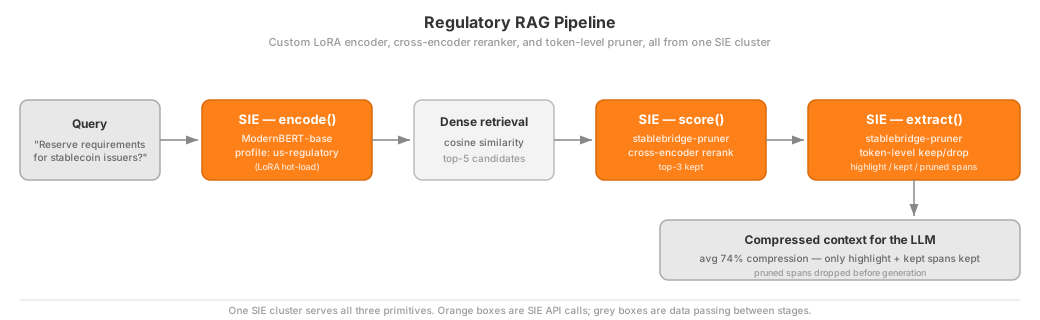
Detail per stage:
- Encode:
ModernBERT-basewith theus-regulatoryprofile, which hot-loads thesugiv/modernbert-us-stablecoin-encoderLoRA weights at request time. Produces a 768-dim domain-adapted embedding. - Dense retrieval: in-memory cosine similarity over the corpus, top-5 kept.
- Score / Rerank:
sugiv/stablebridge-pruner-highlightercross-encoder, keeps top-3. - Extract / Prune: same Stablebridge model, second primitive. Returns token-level keep/drop probabilities aggregated into
highlight/kept/prunedspans. - LLM context: the surviving
highlightandkeptspans become the compressed context passed downstream. Averages 74% compression vs. the raw reranked passages.
Why this example exists
Section titled “Why this example exists”Most OSS inference servers assume you are running off-the-shelf models. Real teams don’t. They fine-tune encoders on their domain, they train pruner heads to cut LLM context costs, they mix and match. This example shows the full path (extend the server, register new models, hit them from the SDK) using a regulatory-intelligence use case built on public-good data.
Two model additions drive the pipeline:
| Model | Base | Task | What it adds |
|---|---|---|---|
sugiv/modernbert-us-stablecoin-encoder | answerdotai/ModernBERT-base | encode | LoRA adapter (r=16, α=32, 8.77 MB) fine-tuned on US stablecoin regulations. Hot-loaded via the us-regulatory profile on the base model, no separate deployment. |
sugiv/stablebridge-pruner-highlighter | BAAI/bge-reranker-v2-m3 | score, extract | PruningHead MLP (525K params) on top of the frozen reranker. Produces rerank scores and token-level keep/drop probabilities in one forward pass. |
SIE features demonstrated
Section titled “SIE features demonstrated”| Feature | How it’s used here |
|---|---|
| encode | Domain-adapted dense embeddings (ModernBERT + LoRA) |
| score | Cross-encoder reranking of retrieved candidates |
| extract | Token-level pruning + sentence-level highlight spans |
| profiles | us-regulatory profile activates LoRA weights at request time |
| custom adapter | StablebridgePrunerAdapter extends sie_server.adapters.ModelAdapter to add pruning under the extract primitive |
| cost-based batching | SIE batches by token count, handling variable-length regulatory docs |
| model sharing | Encoder + pruner share one GPU via SIE’s LRU memory management |
Quick start
Section titled “Quick start”1. Build a custom sie-server image
Section titled “1. Build a custom sie-server image”Everything the pipeline needs on the server side is packaged in server-plugin/: the patch, the adapter, the YAMLs.
# From this directorydocker build -t sie-regulatory --build-arg SIE_TAG=latest-cuda12-default ./server-plugindocker run --gpus all -p 8080:8080 sie-regulatory# CPU-only also works for the tiny sample corpus:# docker build -t sie-regulatory --build-arg SIE_TAG=latest-cpu-default ./server-plugin# docker run -p 8080:8080 sie-regulatorySee the server-plugin README for what is in the image and how to extend it further.
2. Run the pipeline
Section titled “2. Run the pipeline”# No dependencies to install; the client uses stdlib urllib.python rag_pipeline.pyOptions:
--url URL SIE server URL (default: http://localhost:8080)--query TEXT Custom query (default: runs all sample regulatory queries)--top-k N Candidates from dense retrieval (default: 5)--output PATH Save results as JSON--quiet Minimal outputBenchmark results (RTX PRO 6000 Blackwell, 98GB VRAM)
Section titled “Benchmark results (RTX PRO 6000 Blackwell, 98GB VRAM)”| Operation | Mean Latency | p95 Latency | Notes |
|---|---|---|---|
| Encode (base) | 20 ms | 25 ms | 768-dim dense embedding |
| Encode (LoRA) | 23 ms | 27 ms | +3 ms for LoRA adapter switch |
| Score (2 candidates) | 15 ms | 17 ms | Cross-encoder reranking |
| Score (10 candidates) | 19 ms | 21 ms | Sub-linear scaling |
| Extract (single doc) | 17 ms | 19 ms | Pruning + highlighting |
| E2E Pipeline | 61 ms | 66 ms | Encode, then Score(5), then Extract(1) |
100% correct ranking on relevant vs. irrelevant passages. Average 74% character-count compression on the final context vs. the raw reranked passages. On smaller GPUs (A10G, L4) expect 3 to 4 times these numbers.
regulatory-rag/├── rag_pipeline.py # 3-stage RAG pipeline (stdlib only)├── sample_corpus.json # 12 US regulatory passages├── README.md└── server-plugin/ ├── README.md # What the plugin does, how to extend it ├── Dockerfile # Builds sie-server with the extensions baked in ├── encode_lora_routing.patch ├── adapters/ │ └── stablebridge_pruner/ │ └── __init__.py # Custom ModelAdapter, 659 lines └── models/ ├── answerdotai__ModernBERT-base.yaml └── sugiv__stablebridge-pruner-highlighter.yamlArchitecture notes
Section titled “Architecture notes”LoRA as a profile. SIE serves LoRA adapters by loading the base model once and activating LoRA weights via named profiles. When the pipeline calls encode("answerdotai/ModernBERT-base", profile="us-regulatory"), SIE applies the sugiv/modernbert-us-stablecoin-encoder weights to the shared base, with no separate deployment or rebuild. Swap in another LoRA by adding another profile block to the model YAML.
The pruner as an adapter. StablebridgePrunerAdapter wraps a frozen BAAI/bge-reranker-v2-m3 with a trained PruningHead MLP (1024 to 512 to 1). It exposes both score() and extract() from the same forward pass. The classifier output becomes the rerank score, the per-token hidden states become keep/drop probabilities. That is a new kind of primitive that would not exist in a stock embedding server.
Entities are just SIE entities. The pruner returns semantic labels you can filter on downstream:
highlight(score ≥ 0.9): directly answers the querykept(score ≥ 0.6): supporting context worth preservingpruned(score < 0.6): can be safely removedsummary: compression statistics
Credits
Section titled “Credits”Built by @sugix as part of the SIE alpha tester program. LoRA training used answerdotai/ModernBERT-base on a curated corpus of US stablecoin regulation; pruner head trained on BEIR-style relevance judgments.
License
Section titled “License”Apache 2.0, same as SIE.
By Sugi Venugeethan.