
Every checked heading and figure comes back as Markdown
Superlinked gives your agent one API to turn PDFs, decks, papers and forms into Markdown it can chunk and index.
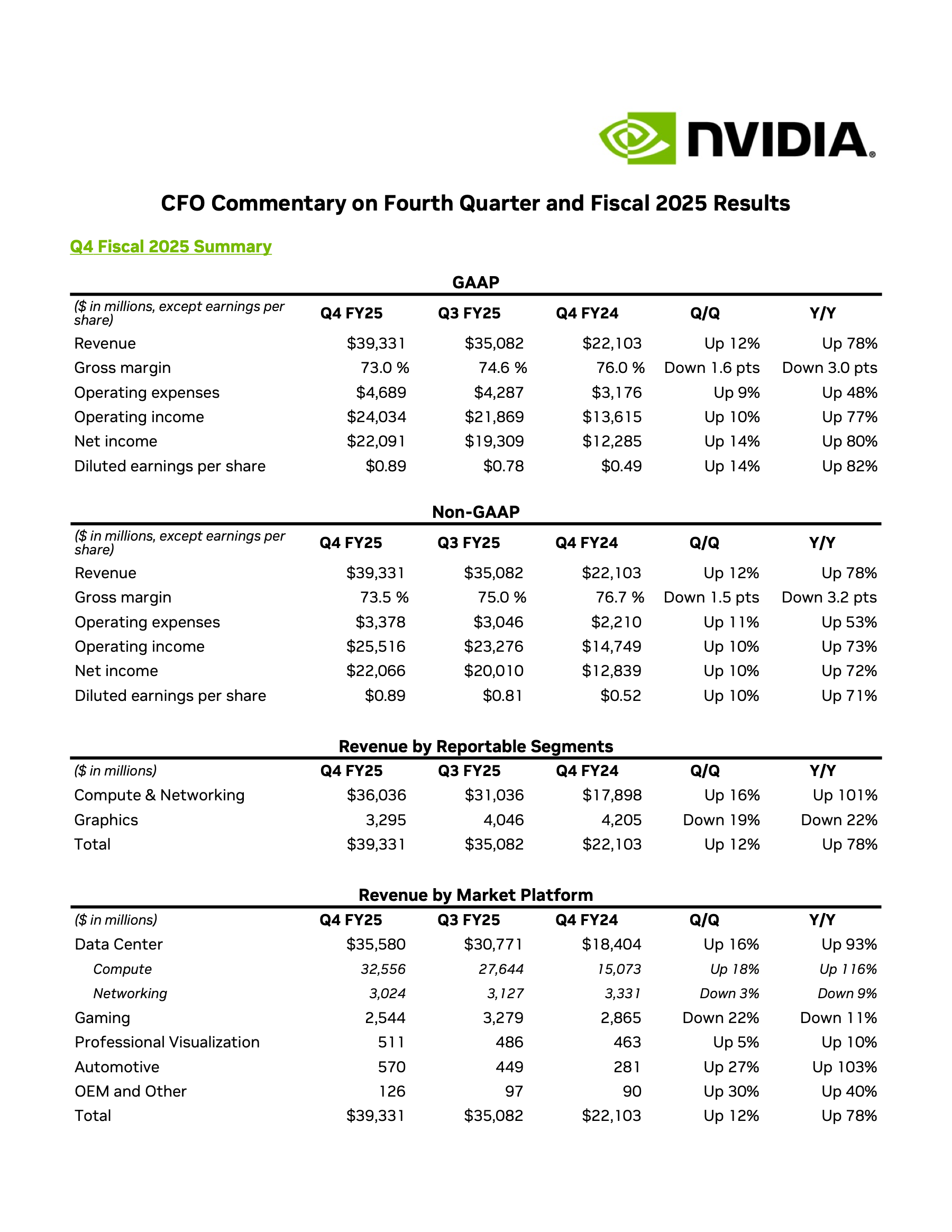
## First Quarter of Fiscal 2026 Outlook

Outlook for the first quarter of fiscal 2026 is as follows:

- Revenue is expected to be $43.0 billion, plus or minus 2%.
- GAAP and non-GAAP gross margins are expected to be 70.6% and 71.0%, respectively, plus or minus 50 basis points.
- GAAP and non-GAAP operating expenses are expected to be approximately $5.2 billion and $3.6 billion, respectively.
- GAAP  and  non-GAAP  other  income  and  expense  are  expected  to  be  an  income  of approximately $400 million, excluding gains and losses from non-marketable and publicly-held equity securities.
- GAAP and non-GAAP tax rates are expected to be 17.0%, plus  or  minus  1%,  excluding  any discrete items.
All 9 lines of the First Quarter of Fiscal 2026 Outlook section
25 of 25 checks passed, on four documents of four different kinds
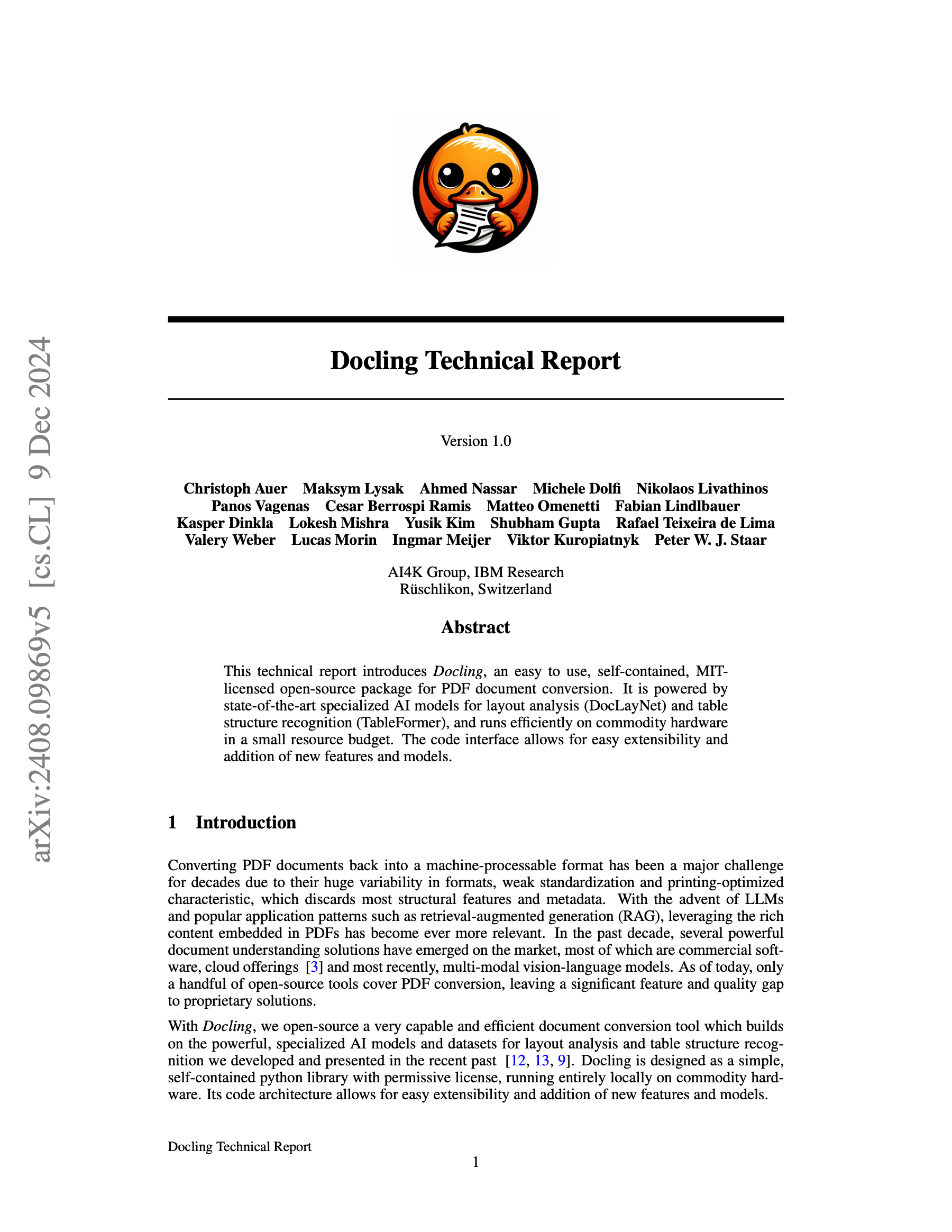
The two-column paper comes back in reading order
## Abstract

This technical report introduces Docling , an easy to use, self-contained, MITlicensed open-source package for PDF document conversion. It is powered by state-of-the-art specialized AI models for layout analysis (DocLayNet) and table structure recognition (TableFormer), and runs efficiently on commodity hardware in a small resource budget. The code interface allows for easy extensibility and addition of new features and models.
Abstract, introduction and architecture arrive in that order, one column at a time, which is what a chunker needs and what a naive text dump of a two-column PDF interleaves. One hyphen does not survive the trip: MIT-licensed was broken across a line in the PDF and comes back as MITlicensed.
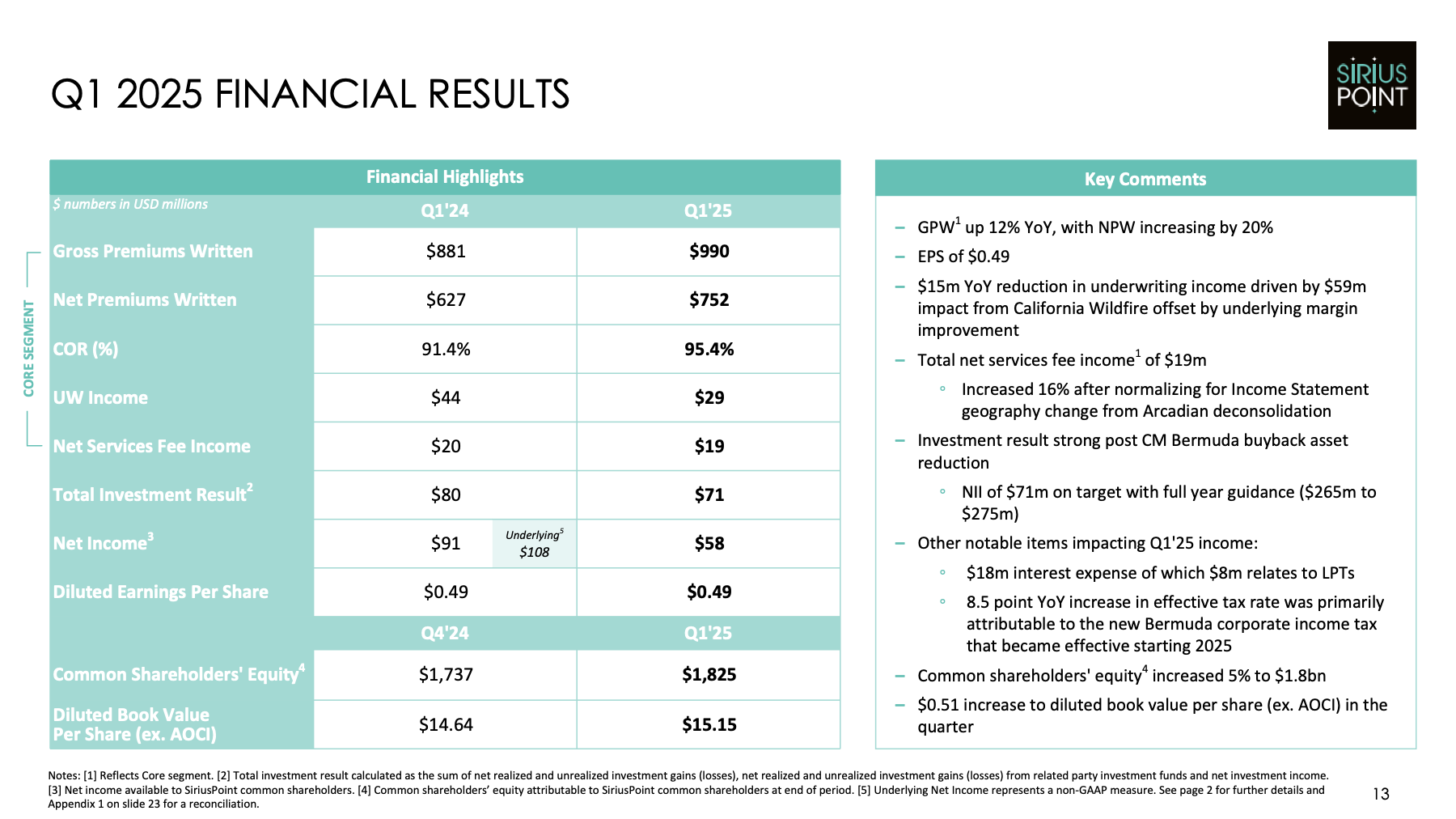
Every figure in the highlights table comes back in its own cell
## Q1 2025 FINANCIAL RESULTS

| Financial Highlights                    | Financial Highlights   | Financial Highlights   | Financial Highlights   |
|-----------------------------------------|------------------------|------------------------|------------------------|
| $ numbers in USD millions               | Q1'24                  | Q1'24                  | Q1'25                  |
| Gross Premiums Written                  | $881                   | $881                   | $990                   |
| Net Premiums Written                    | $627                   | $627                   | $752                   |
| COR (%)                                 | 91.4%                  | 91.4%                  | 95.4%                  |
Showing 5 of the 13 rows the model returned for this table
Every number keeps the cell it was printed in, down to the percent signs. The header row is where it gives way: Financial Highlights repeats across all four cells and the Q1'24 column comes back twice, so nothing in the Markdown says which quarter a figure belongs to. Further down the same table the two copies of Q1'24 stop agreeing, $91 in one and Underlying 5 $108 in the other.
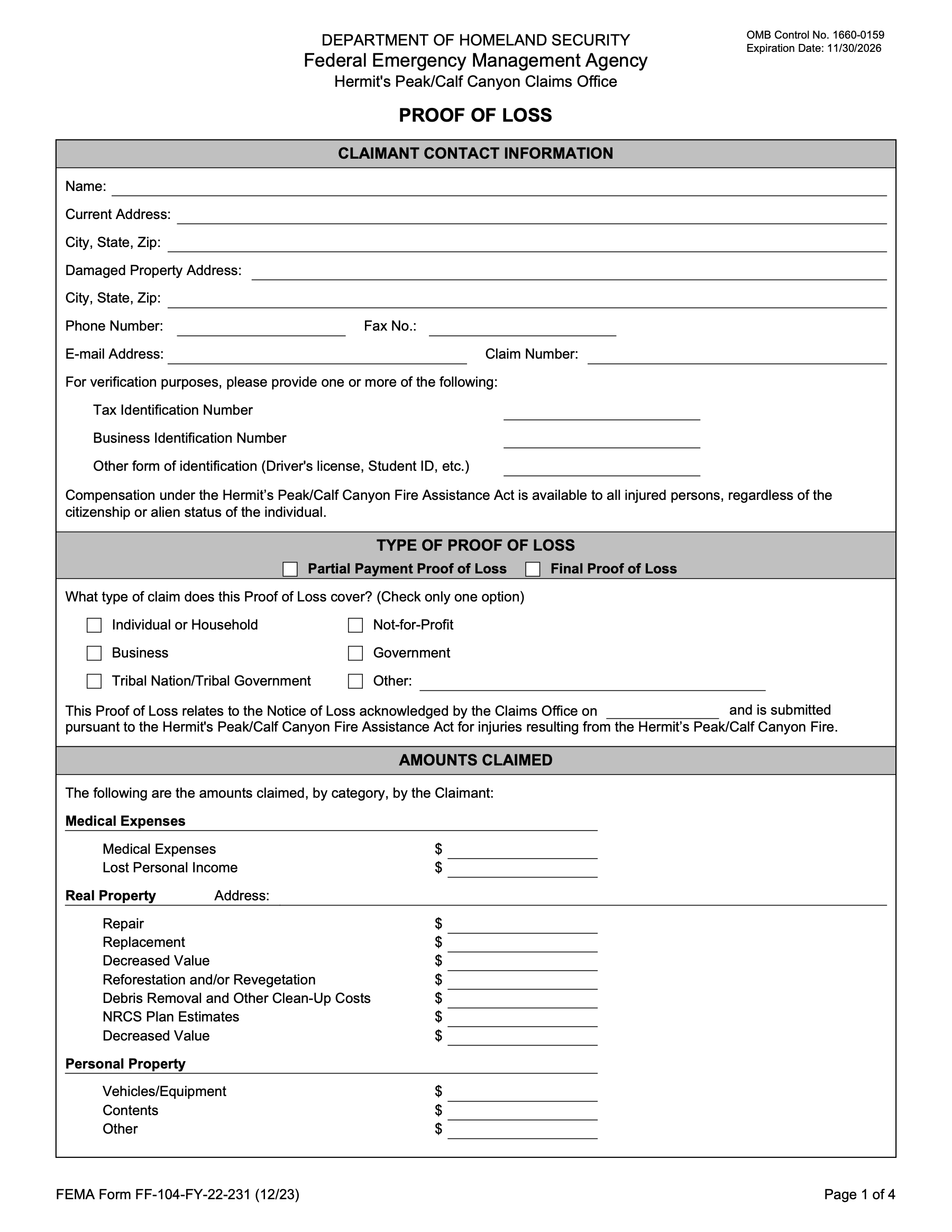
Every field and every checkbox choice on the form page comes back
- [ ] Individual or Household

- [ ] Business

- [ ] Government

- [ ] Tribal Nation/Tribal Government

- [ ] Not-for-Profit

- [ ] Other:
All twelve amount labels on the page shown come back, and so do the six claim-type choices, each as an unticked Markdown checkbox. The amounts arrive in a run of their own: 26 bare $ symbols on lines that carry no label, so nothing in the Markdown says which amount belongs to which category. The six choices land under `## Real Property`, 32 lines after the question they answer.
25 of 25 checks passed over the 4 documents in this run: the three on these cards, and the financial report in the hero. 18 of the checks look for a named heading or figure in the Markdown that came back, 3 check that sections arrive in document order, and 4 count the tables. None of them looks at whether a table keeps its column headings, which is where this run thins out; the caption on each card says where.
The whole document comes back as one Markdown string
from sie_sdk import SIEClientclient = SIEClient( api_key="sk-sie-…", base_url="https://api.superlinked.com",)# Parse a document → clean markdown, tables and layout kept.result = client.extract( "modeldocling", {"document": filePDFnvidia-q4-fy2025-cfo-commentary.pdfbrowse},)print(result["data"]["markdown"])document_bytes=$(base64 < 'nvidia-q4-fy2025-cfo-commentary.pdf' | tr -d '\n')
curl https://api.superlinked.com/v1/extract/docling \
-H "Authorization: Bearer sk-sie-…" \
-H "Content-Type: application/json" \
-d "{\"items\":[{\"document\":{\"data\":\"$document_bytes\",\"format\":\"pdf\"}}]}"Build the "Doc to Markdown" capability into my app using the Superlinked Inference Engine (SIE).
Context
- SIE is an OpenAI-style inference API. Python SDK: `from sie_sdk import SIEClient`; TypeScript: `@superlinked/sie-sdk`.
- Base URL: https://api.superlinked.com (or my regional endpoint). Auth: Bearer key from env `SIE_API_KEY` (never hard-code it).
- Model: docling (SIE primitive: /extract). Keep the model id configurable.
Task
- Input: an uploaded document (PDF / Office / scan).
- Behaviour: return clean markdown for the document, preserving tables and reading order
- Call the selected SIE primitive once per request and map the response into your domain type.
Deliverables
- A typed client wrapper, an application-level function for this task, error handling for timeouts/empty input, and unit tests with a stubbed client.
- Wire it into my existing stack (ask me which framework if unclear) and add a short usage example.Q4 Fiscal 2025 Summary
| GAAP | GAAP | GAAP | GAAP | GAAP | GAAP |
|---|---|---|---|---|---|
| ($ in millions, except earnings per share) | Q4 FY25 | Q3 FY25 | Q4 FY24 | Q/Q | Y/Y |
| Revenue | $39,331 | $35,082 | $22,103 | Up 12% | Up 78% |
| Gross margin | 73.0 % | 74.6 % | 76.0 % | Down 1.6 pts | Down 3.0 pts |
- Extracts clean, agent-ready markdown
- Keeps tables and layout intact
Document extraction quality and latency
Deploy your way
Managed Cloud
Full compute toolkit for your agents with zero ops.
- No idle GPUs, pay for what you use
- Fits your stack: SDK, API, CLI, MCP
- Zero lock-in, self-host the same stack
- SOC 2 Type 2, US or EU data residency
no credit card required
Self-host with K8s
Easy & scalable deployment in your own cloud.
- Terraform to your cloud in minutes
- Apache-2.0, same engine as Cloud
- Scales to zero, no bill between jobs
- Per-tenant pools, no noisy neighbors
Deploy SIE to our AWS account with the superlinked/sie/aws Terraform module. Docs: superlinked.com/docs/deploymentDeploy SIE to our GCP project with the superlinked/sie/google Terraform module. Docs: superlinked.com/docs/deploymentDeploy SIE to our Azure AKS cluster via helm install. Requirements: superlinked.com/docs/deployment Run locally
Run the same models on your own machine.
- Runs on NVIDIA GPU or Apple Silicon
- One command, no Docker or cluster
- All 100+ Cloud models, fully offline
- Same SDK and IDs, no code changes
pip install "sie-server[local]" && sie-server servepip install "sie-server[local]" && sie-server serve --device cuda